

Example: configure the supplier input
After the supplier predicate matches, this sample uses Override to supply{ "supplierId": "VEGA" } as runtime input to Supplier stock intake. The Job reads api.input('templateInputs'). The message filter decides whether dispatch is eligible; the input mode decides what the selected Job receives. Changing one does not automatically change the other.
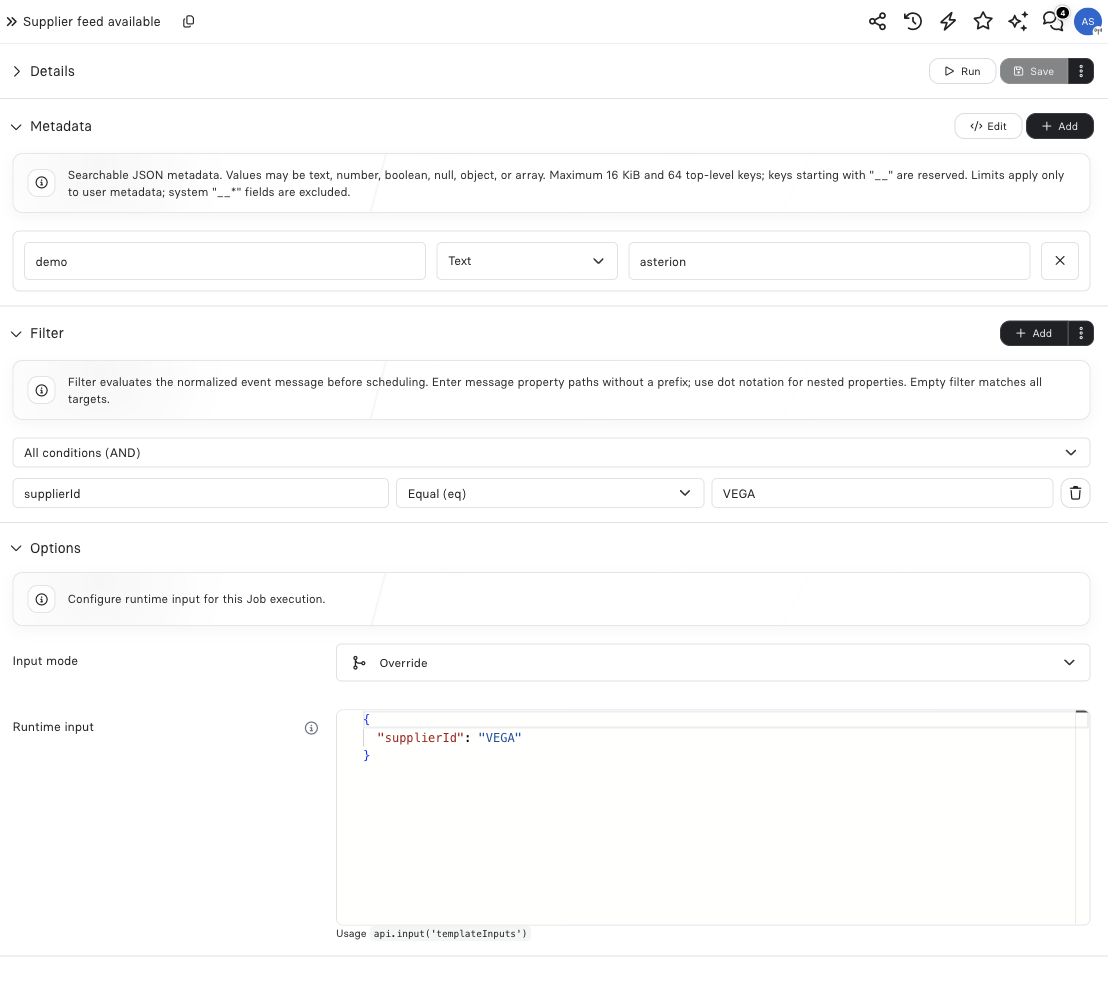
Filter, input mode and JSON input are separate configuration controls.
Configure Runtime input for a Job target
Select a Job target, then use the expanded Options section at the bottom of the Event editor. Runtime input uses the same JSON-object editor as Job templates. The Input mode dropdown shows Override, Deep Override and Replace, with icons and descriptions.
Override is shallow: a supplied nested object or array replaces the whole value at that key. Values such as
false, 0, and null inside the object are retained. The root must be an object; arrays, strings, numbers, and null are rejected.
Use Deep Override to change part of a nested configuration. For example, Job defaults { "export": { "format": "csv", "encoding": "utf8" } } and automation input { "export": { "format": "xlsx" } } produce { "export": { "format": "xlsx", "encoding": "utf8" } }. An empty nested object preserves existing nested values; a change of value type replaces the whole value. Arrays are never concatenated, and null does not delete a field. Existing Override and Replace behavior is unchanged.
For example, a Job template with { "region": "eu", "mode": "incremental" } and an Event with { "mode": "full" } in Override mode execute with { "region": "eu", "mode": "full" }.
The Platform API uses these fields on the Event definition:
templateInputs; it does not replace the Event message, type, or user metadata. Agent delivery remains configured through its target settings.
The Platform API uses inputMode: "override" for Override, inputMode: "deep_override" for Deep Override and inputMode: "replace" for Replace, matching the UI. Existing definitions are migrated without changing their effective behavior.
New definitions default to input: {} and inputMode: "override", preserving Job defaults. On an API update, omitted fields retain their stored values. Send both input: {} and inputMode: "override" to restore the default configuration.
Each accepted delivery retains its Runtime input and mode. Editing the Event changes future deliveries; it does not rewrite the input of Jobs already queued or running, or their retry attempts. The Job template continues to own execution policy, concurrency, and retry settings.
Continue with events.